


Top casinos


18+ · T&Cs Apply · Play Responsibly


18+ · T&Cs Apply · Play Responsibly

18+ · T&Cs Apply · Play Responsibly
18+ · T&Cs Apply · Play Responsibly
18+ · T&Cs Apply · Play Responsibly


18+ · T&Cs Apply · Play Responsibly

18+ · T&Cs Apply · Play Responsibly
18+ · T&Cs Apply · Play Responsibly
18+ · T&Cs Apply · Play Responsibly
18+ · T&Cs Apply · Play Responsibly
18+ · T&Cs Apply · Play Responsibly
18+ · T&Cs Apply · Play Responsibly
18+ · T&Cs Apply · Play Responsibly

18+ · T&Cs Apply · Play Responsibly
18+ · T&Cs Apply · Play Responsibly
Compare the top casinos side by side across games, payments, bonuses and safety. Confirm current terms before depositing.
| Attribute | | | |
|---|---|---|---|
| Rating Editorial score from licensing, payments, games, and player-protection checks. It is not a prediction of your results. | ★★★★½ 8.9/10 | ★★★★★ 9.5/10 | ★★★½☆ 7.0/10 |
| Welcome Bonus Headline welcome offer from current provider data. Check wagering, minimum deposit, and expiry on the operator site before claiming. | RF 2,000,000 + 150 FS | RF 260,000 | RF 1,500,000 |
| Year Established | 2016 | 2007 | 2016 |
| Games | 2,000 | 7,000 | 8,000 |
| Payout Rate (RTP) Return to player (RTP) is the long-run share of stakes a game pays back. The figure here is an average across titles, not a guarantee for one session. | 97% | 95% | 94% |
| License The regulator named here is the authorisation we could verify. Confirm the current licence on the operator site and the public register before depositing. | Curacao | Panama Gaming Control Board | Curacao |
| Payment Methods | Credit Cards, inviPay, Bank Transfer, Bitcoin, Litecoin, Dogecoin | Bitcoin, Litecoin, Dogecoin, EasyPay, Paysec THB, UTEL | Bitcoin, Ethereum, Pix, Perfect Money, Ripple, Tether |
| Get Started |

How Parlay Bets Work: Understanding Multi-Leg Mechanics for Rwandan Players
A parlay bet combines two or more individual selections, called legs, into a single wager. All legs must win for the parlay to cash. If even one leg loses, the entire bet fails.
Building Your Parlay Bet
When creating a parlay, a bettor selects multiple events — for example, a football team to win, a basketball game to go over 210 points, and a tennis player to advance. Each selection is a “leg.” The odds from each leg are multiplied together to create a combined line.
- Minimum Legs: Most sportsbooks require at least two selections.
- Maximum Legs: Some allow 10, 15, or even 20 legs. The more legs, the larger the potential payout but the slimmer the chance of winning.
Understanding Pushes and Voids
If a leg results in a push (e.g., a point spread lands exactly), that leg is removed and the parlay recalculates with the remaining selections. If a game is voided (e.g., canceled), the bet continues with fewer legs.
The Risk of Losing Just One Leg
If just one leg loses, the entire parlay loses. This all-or-nothing feature is why parlays are high-risk but attractive to bettors seeking big payouts from small stakes.
A Practical Parlay Example
A three-leg parlay with decimal odds of 2.00, 1.80, and 1.50 multiplies to 5.40. A stake of RWF 50,000 would return RWF 270,000 if all legs win, but nothing if one leg fails.
The Math Behind Parlay Payouts for Rwandan Gamblers
Parlay payouts are calculated by multiplying the odds of each leg, which creates the potential for massive returns — but the implied probability of winning drops sharply as more legs are added. This is especially true for Rwandan players making multiple selections.
How Parlay Odds Are Calculated
Bookmakers use the same formula across odds formats:
- Decimal odds: Multiply the decimal prices of each leg.
- Fractional odds: Convert to decimal, multiply, then reconvert.
- American odds: Convert to decimal first, then multiply.
Example:
- Leg 1: 2.00
- Leg 2: 1.80
- Leg 3: 1.50 Parlay odds = 2.00 × 1.80 × 1.50 = 5.40. A RWF 50,000 stake returns RWF 270,000 (RWF 220,000 profit).
Understanding Implied Probability
Implied probability is the chance of all legs hitting. It’s calculated as:
1 / Parlay Odds
In the example above: 1 / 5.40 = 18.5% chance of success. Even though each leg individually had a high probability, combining them slashes the overall likelihood for Rwandan bettors.
Expected Value (EV) Considerations
Parlays typically have a negative expected value because of the bookmaker’s margin. Each leg includes a small house edge, and multiplying legs compounds this margin. That’s why sportsbooks encourage parlays — they’re harder to win consistently than singles. For Rwandan players, understanding this is key to responsible gambling.
Single Bets vs. Parlays
If you placed $50 individually across the same three bets, you’d likely see steadier returns, even if one selection lost. In contrast, the parlay offers a higher payout but zero return if one leg fails.
Why Bettors Use Parlays
Bettors use parlays because they offer the chance to turn small stakes into disproportionately large payouts, making them both exciting and cost-effective entertainment.
- High Payout Potential. The biggest draw is exponential returns. Multiplying odds allows bettors to risk as little as $5–$10 for a potential payout worth hundreds, depending on the number of legs.
- Entertainment Value. Parlays heighten the drama of watching multiple games—every leg matters, keeping bettors invested across different matches and sports.
- Convenience. Instead of placing several singles, parlays consolidate picks into one ticket. This saves time and adds a layer of simplicity for casual bettors.
- Linking Outcomes. Some bettors enjoy connecting correlated results, such as a quarterback's passing yards being tied to his team winning. While these combinations are risky, they enhance the sense of strategic play.
- Psychological Appeal. The “lottery effect” — risking little for the chance of a big win — makes parlays highly engaging, even though long-term profitability is low.
Strategies for Smarter Parlay Betting
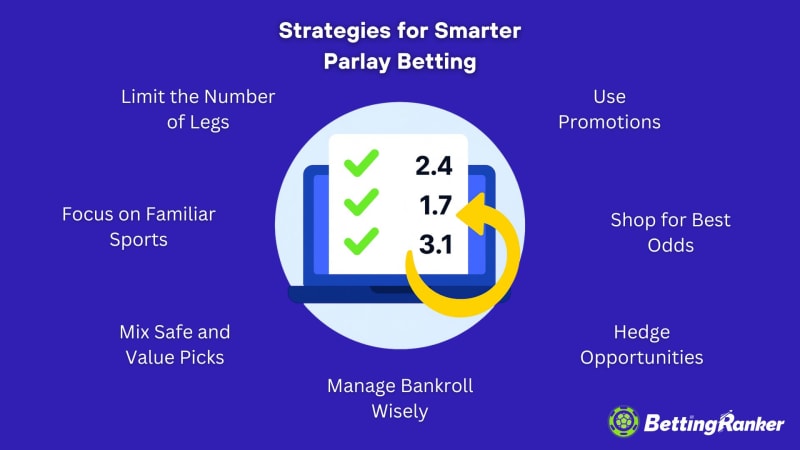
Parlays are inherently high-risk, but applying disciplined strategies — such as limiting the number of legs and managing your bankroll — can reduce variance and increase long-term sustainability.
- Limit the Number of Legs. The probability of hitting decreases sharply with every added leg. For casual bettors, sticking to 2–4 legs balances payout potential with realistic success rates.
- Focus on Familiar Sports. Specializing in leagues or teams you already follow gives you an edge when analyzing matchups. Avoid “throw-in” legs just to boost odds.
- Mix Safe and Value Picks. Combining low-risk selections (e.g., heavy favorites) with one or two high-value underdogs can enhance payouts without overly tanking probability.
- Manage Bankroll Wisely. Never risk more than a small percentage of your total bankroll on parlays. A smart staking plan ensures losses don’t spiral.
- Hedge Opportunities. If a parlay reaches the final leg, consider hedging with a single bet against your last selection. This locks in partial profits, even if the parlay fails.
- Shop for Best Odds. Small differences in prices across sportsbooks can significantly impact multi-leg payouts. Always compare before finalizing your ticket.
- Use Promotions. Take advantage of parlay boosts, insurance, and cash-out options to add expected value to your bets.
While no system guarantees consistent profit, disciplined bettors who combine smart staking and informed selections can get far more from parlays than casual players chasing “lottery wins.” For deeper insights into bankroll discipline and wagering models, see our full guide on betting strategy.
Advanced Parlay Concepts
Beyond standard parlays, advanced bet types like correlated parlays, round robins, and teasers offer bettors more flexibility — but also come with unique risks and rules.
Correlated Parlays
A correlated parlay combines outcomes that are statistically linked. For example, betting both “Team A to win” and “Quarterback Over 300 passing yards” in the same game. If the QB exceeds 300 yards, the team is more likely to win.
- Many sportsbooks restrict or block these because they reduce the house edge.
Round Robins
A round robin breaks a large parlay into smaller sub-parlays. For instance, a 4-leg round robin might generate multiple 2-leg and 3-leg combinations.
- ✅ Benefit: If one leg loses, some combinations may still cash.
- ❌ Drawback: Requires a higher total stake, as you’re effectively placing multiple bets at once.
Teasers
Teasers are adjusted-line parlays, commonly used in American football and basketball. Bettors can shift point spreads or totals in their favor across multiple legs. Example: Teasing a -7 favorite to -1, and an Over 48 total down to Over 42.
- ✅ Lower risk compared to standard parlays.
- ❌ Reduced payout due to more favorable lines.
Advanced parlays expand your toolkit, but they demand awareness of bookmaker rules and pricing. Used wisely, they can create more balanced risk–reward profiles than traditional “all-or-nothing” accumulators.
Parlay-Specific Promotions
Sportsbooks heavily promote parlays with boosts, insurance, and cash-out options, because while they’re attractive to bettors, they are also profitable for the house. Used correctly, these promotions improve your expected value slightly, making parlays more appealing. However, they don’t change the core fact: parlays remain high-risk bets, best enjoyed in moderation.
Parlay Boosts
Many operators offer percentage boosts (e.g., +20% payout) when your parlay hits a certain number of legs. This increases winnings without raising your stake — though only if every leg wins.
Parlay Insurance
Some sportsbooks refund your stake (often as free bets) if one leg of your parlay loses. For example, a 5-leg parlay might qualify for insurance if exactly four win.
Early Cash-Out
Cash-out features allow bettors to settle parlays before all legs conclude. This allows you to lock in a profit if most legs have already won, or minimize losses if things look unfavorable.
Common Mistakes in Parlay Betting
Most bettors lose on parlays not because the format is broken, but because they fall into predictable traps such as overloading legs, chasing unlikely payouts, and ignoring value.
- Adding Too Many Legs. The allure of huge payouts leads many to build 10+ leg parlays, where the probability of winning is vanishingly small.
- Relying on Long Shots. Throwing in big underdogs may look attractive, but it often collapses the entire bet. Value should be calculated, not guessed.
- Ignoring Odds Value. Multiplying poor odds only amplifies the bookmaker’s margin. Bettors should always shop for the best prices before locking in a parlay.
- Overexposure on One Game. Including multiple correlated markets from the same match without realizing it increases risk. Some books disallow these entirely.
- Poor Bankroll Management. Wagering large portions of your bankroll on parlays exposes you to quick losses. Parlays should supplement singles, not replace them.
Parlays vs. Other Betting Systems
Parlays are fundamentally different from low-risk betting systems, such as matched betting or arbitrage. They offer bigger payouts but far less consistency, making them an entertainment-focused option rather than a profit-driven strategy.
System | Risk Profile | Goal | Example |
|---|---|---|---|
Parlays | High risk, high reward | Entertainment & big payouts | $20 4-leg parlay can pay $400+ but loses if one leg fails. |
Very low risk (promo-based) | Extract bookmaker bonuses | Use free bet on both sides of an outcome to guarantee profit. | |
Low risk (requires precision) | Lock in guaranteed returns | Exploit odds differences between two sportsbooks for a sure profit. | |
Singles/Value Betting | Medium risk (skill-based) | Long-term profitability | Consistently back +EV single wagers. |
🎯 Key Takeaway
- Parlays = high variance, entertaining, low long-term EV.
- Matched betting/arbitrage = structured, profit-focused approaches.
- Singles = balance between fun and sustainability.
Conclusion: Are Parlays Worth It?
Parlays are high-risk, high-reward bets. They appeal to bettors who value excitement and big payouts, but they are rarely the most efficient path to long-term profitability.
Used wisely, parlays can be part of a broader betting approach — especially when combined with strategies such as limiting legs, hedging, and utilizing bookmaker promotions. However, they should never replace disciplined bankroll management or safer systems such as matched or arbitrage betting.
If you want to deepen your knowledge of betting formats beyond parlays, explore our expert-reviewed betting guides, where we break down strategies, mechanics, and tools to help you bet smarter.
Frequently Asked Questions
What is a parlay bet in sports betting?
A parlay, sometimes called a multiple, is a single bet that combines several individual wagers, known as "legs." All legs must win for the parlay to be successful. If even one leg loses, the entire parlay loses. Because the odds of each leg are multiplied together, the potential payout is significantly higher than placing each bet separately, but the risk is also much greater. Parlays are popular in Rwanda for those seeking larger payouts from smaller stakes.
What happens if one leg of my parlay is a push or voided?
If one leg of your parlay results in a push (e.g., the point spread lands exactly on the predicted value) or is voided (e.g., the event is canceled), most sportsbooks will remove that leg from the parlay and recalculate the odds based on the remaining legs. The parlay bet then continues with the adjusted odds.
What is the difference between a parlay and an accumulator bet?
The terms "parlay" and "accumulator" are essentially interchangeable. "Parlay" is more commonly used in the United States, while "accumulator" is more frequently used in Europe and other parts of the world. Both terms refer to a multi-leg bet where all selections must win for the bet to pay out.
How many legs should I include in a parlay bet?
There is no definitive rule, but most experienced bettors recommend limiting parlays to between 2 and 4 legs. This strikes a balance between the potential payout and the probability of success. While parlays with a large number of legs may advertise substantial payouts, the chances of winning are significantly reduced. Always bet responsibly and within your means.
How are parlay odds calculated in sports betting?
Parlay odds are calculated by multiplying the odds of each individual leg. For example, if you have three legs with decimal odds of 2.00, 1.80, and 1.50, the parlay odds would be 2.00 x 1.80 x 1.50 = 5.40. Therefore, a 5,000 RWF stake would return 27,000 RWF if all legs win. The same calculation applies to fractional and American odds after converting them to decimal format.
Are parlay bets a profitable long-term strategy?
Generally, parlays are not considered a profitable long-term betting strategy. The bookmaker's margin is compounded across each leg, resulting in a lower expected value compared to single bets. While parlays can offer the chance of a large payout, they are statistically less likely to be successful over time. Many bettors in Rwanda view them as a form of entertainment rather than a reliable source of income. Remember to gamble responsibly.
Can I cash out a parlay bet early?
Yes, many online sportsbooks offer an early cash-out option for parlay bets. This feature allows you to settle your bet before all legs have finished, securing a guaranteed profit if your selections are performing well or minimizing potential losses if one or more legs appear to be at risk. The availability of this option depends on the specific sportsbook you are using.